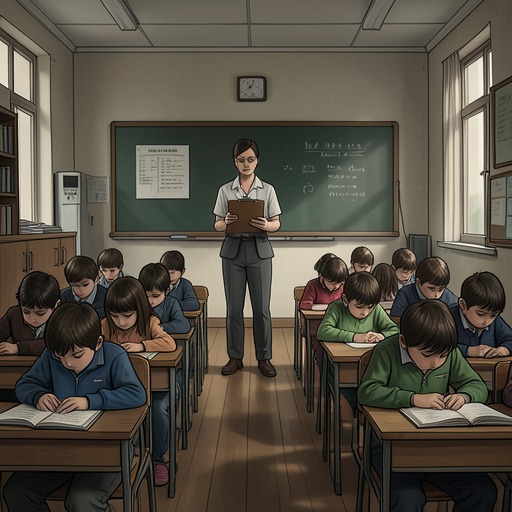
Woody Elementary
Lessons in ChemistryWoody Elementary is the school where Madeline Zott begins kindergarten early, in Room six under Mrs. Mudford. Its brief appearances make it a testing ground for the difference between Madeline’s capabilities and the narrow expectations placed on girls: she arrives already reading, athletic, and practiced in practical skills, while school life marks out which interests are considered appropriate for her.
Setting and Introduction
Elizabeth Zott gives Harriet Sloane a sheet identifying Woody Elementary, Mrs. Mudford, and Room six. Madeline is technically too young for kindergarten, but Elizabeth has altered the birth certificate by determining the chemical composition of ballpoint-pen ink. She does not regard the age rule as a reason to delay her daughter’s education.
Madeline’s First Day
On Madeline’s first day, her teacher tries to pin a pink flower to her blouse. Madeline asks for a blue one instead, but the teacher refuses on the grounds that blue is for boys and pink is for girls. The exchange makes the school’s gender coding concrete: even a small classroom gesture assigns children identities before their abilities are considered.
Mrs. Mudford and the School’s Expectations
Mrs. Mudford’s notes to Elizabeth become a recurring sign of her disapproval. She objects to Madeline’s reading, her ability to kick a ball, and her knowledge of complicated nautical knots. Madeline practices those knots frequently, even in the dark and rain and without help, prepared for a circumstance the evidence does not specify. Her competence crosses the categories the school seems to expect of her, making the notes less a measure of what she can do than a record of how unsettled those expectations leave her teacher.
Narrative Significance
Woody Elementary brings the novel’s concern with gendered instruction into an ordinary school setting. The pink-flower incident and Mrs. Mudford’s complaints contrast with Elizabeth’s conviction that Madeline should learn without being held back by technicalities or conventional limits. The school is not depicted through a broad account of its institution or grounds; its significance emerges through these encounters, in which everyday rules and judgments meet a child whose interests refuse to stay within them.